

What Does BDSM Stand For? A Plain English Glossary











BDSM for Beginners: A Complete Guide to Terminology and Dynamics
BDSM is one of the most searched topics in modern sexuality, yet it's also one of the most misunderstood. This guide breaks down BDSM terminology in plain English so beginners can explore the language, dynamics, and ideas behind BDSM without feeling overwhelmed or intimidated.
For some people, BDSM feels exciting but intimidating. Others are curious about dominance, submission, bondage, or power play but feel overwhelmed by the terminology. Words like "Dom," "sub," "switch," "aftercare," and "safe words" get thrown around constantly online, often without much explanation.
The truth is, BDSM is not one single thing. It's an umbrella term covering a wide range of consensual dynamics, fantasies, sensations, and relationship styles built around trust, communication, pleasure, control, and exploration.
And despite the stereotypes, most BDSM is not about cruelty, abuse, or extreme behaviour.
Healthy BDSM is based on
- consent
- communication
- emotional trust
- mutual enjoyment
- clear boundaries
- safety and respect
For many couples, it's more about
- anticipation
- teasing
- power dynamics
- surrender
- confidence
- emotional intensity
- deeper intimacy
What Does BDSM Actually Stand For?
BDSM combines several connected categories together:
- B = Bondage
- D = Discipline
- D/s = Dominance and Submission
- S = Sadism
- M = Masochism
Some people enjoy only one part of BDSM. Others enjoy several elements combined together.
For example:
- someone may enjoy light bondage but not pain
- another person may enjoy submission without restraints
- some couples enjoy teasing power dynamics rather than physical intensity
BDSM is highly personal. There is no single "correct" way to explore it.
Bondage
Restraining Movement for Pleasure or Power Play
Bondage refers to physically restricting movement using:
- cuffs
- rope
- restraints
- collars
- tape
- bondage furniture
For many people, the appeal of bondage is psychological as much as physical.
Being restrained can heighten
- anticipation
- vulnerability
- surrender
- sensitivity
- emotional tension
The person in control often enjoys
- teasing control
- authority
- guiding sensation
- watching anticipation build
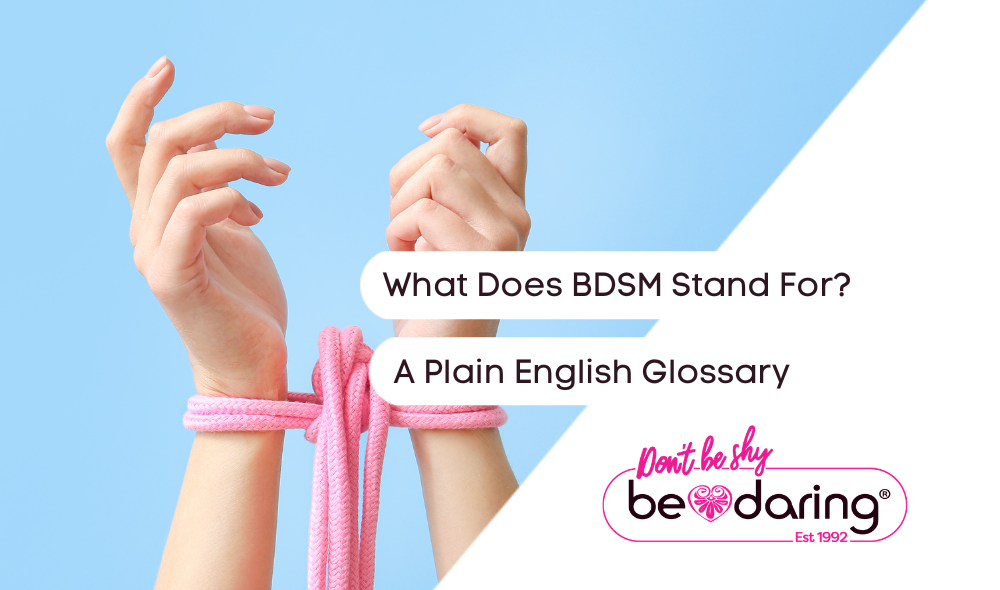
Beginner bondage often starts very simply — wrists restrained above the head, blindfolds, soft cuffs, or beginner-friendly restraint setups designed to create teasing anticipation without overwhelming intensity.
It does not need to involve elaborate rope techniques or extreme scenarios to feel exciting.
Bondage Doesn't Need to Be Complicated
Many people assume bondage requires advanced rope skills or elaborate setups, but most beginners start much more simply. Soft restraints, cuffs, and beginner-friendly bondage products allow couples to explore anticipation, vulnerability, and control without needing specialised knowledge or experience.
The goal is not complexity. It's creating enough restriction and psychological tension to make touch, teasing, and surrender feel more immersive and exciting.
Discipline
Rules, Structure & Obedience
Discipline refers to rules, consequences, structure, and behavioural control within a BDSM dynamic.
For some couples, this may involve:
- playful punishment
- teasing correction
- obedience tasks
- permission-based dynamics
- rewards and consequences
Discipline is often less about punishment itself and more about reinforcing the power dynamic psychologically.
For example:
- asking permission before touching
- following commands
- maintaining eye contact
- playful teasing rules
The emotional tension created through obedience and control is often what makes discipline feel exciting.
Dominance & Submission (D/s)
Power Exchange Dynamics
Dominance and submission form the emotional core of many BDSM experiences.
A Dominant partner takes control or leadership within the dynamic, while the submissive partner consensually surrenders control.
That exchange may involve:
- verbal commands
- restraint
- teasing
- roleplay
- service dynamics
- orgasm control
- psychological tension
Contrary to stereotypes, submission is not weakness.
Many submissives describe surrender as
- emotionally freeing
- deeply trusting
- psychologically immersive
- intensely exciting
Strong Dominants are usually
- attentive
- communicative
- emotionally aware
- calm and controlled
Healthy D/s dynamics rely heavily on trust and communication.
Sadism
Enjoying Giving Sensation or Pain
Sadism refers to pleasure derived from giving pain, sensation, or intense stimulation consensually.
That may include:
- spanking
- paddling
- scratching
- biting
- impact play
- teasing restraint
Importantly, healthy sadism in BDSM is always consensual. The focus is not harm — it's controlled sensation, emotional intensity, and shared pleasure between partners.
Many sadists enjoy reactions, anticipation, control, emotional intensity, and creating heightened physical sensation.
Some BDSM couples enjoy very light sensation play, while others explore more intense impact play gradually over time.
Masochism
Enjoying Receiving Sensation or Pain
Masochism refers to enjoying receiving pain, intense sensation, or physical stimulation consensually.
For masochists, sensation may feel emotionally cathartic, physically exciting, psychologically immersive, or intensely stimulating.
This does not necessarily mean extreme pain. For many people, masochism may simply involve:
- light spanking
- scratching
- biting
- wax play
- pressure or restraint
Pain tolerance and interests vary enormously between individuals.
Common BDSM Terms Explained
Dom / Dominant
The person leading or controlling the dynamic. A Dominant may guide pacing, rules, restraint, teasing, permission, and overall scene direction. Good Dominants focus heavily on communication and attentiveness.
Sub / Submissive
The partner surrendering control consensually within the dynamic. Submission may involve obedience, vulnerability, restraint, receiving commands, service dynamics, and emotional surrender. Submissives still maintain boundaries and consent throughout the experience.
Switch
Someone who enjoys both dominant and submissive roles depending on mood, partner, or situation. Many people discover they enjoy both dynamics differently.
Safe Word
A predetermined word used to immediately pause or stop a BDSM scene. Safe words create safety and clear communication during emotionally or physically intense play.
- "Yellow" = slow down / check in
- "Red" = stop immediately
Safe words are a sign of healthy BDSM, not weakness.
Aftercare
Aftercare refers to emotional and physical care after BDSM play.
- cuddling
- reassurance
- hydration
- checking emotional comfort
- discussing the experience
- helping partners reconnect emotionally
Because BDSM can involve intense vulnerability and adrenaline, aftercare helps both people decompress safely afterwards.
Scene
A BDSM interaction or session. A scene may involve bondage, roleplay, domination, restraint, teasing, or impact play — and can be spontaneous or carefully planned depending on the couple.
Vanilla
A slang term referring to non-kinky or more traditional sexual activity. Importantly, "vanilla" is not an insult. Many people enjoy both vanilla intimacy and BDSM depending on mood and preference.
Impact Play
Physical sensation play involving spanking, paddles, floggers, crops, or slapping. Impact play ranges from playful teasing to more intense sensation depending on the couple, especially when combined with slower sensory build-up and anticipation techniques.
Starting Impact Play Slowly Builds Confidence
For many beginners, impact play feels less intimidating when approached as playful sensation rather than punishment. Light paddles and crops can introduce anticipation, authority, and physical sensation gradually, allowing couples to explore reactions, communication, and comfort levels together.
Many experienced BDSM practitioners recommend starting gently and focusing on communication long before intensity becomes part of the experience.
Collar
A symbolic or functional BDSM accessory often representing ownership, submission, power exchange, or commitment within a dynamic. Some collars are purely bedroom accessories. Others, like day collars, are designed for discreet daily wear.
Brat
A submissive who playfully resists, teases, or challenges the Dominant rather than obeying immediately. Brat dynamics are often playful and flirtatious rather than serious disobedience.
Service Submission
A submissive dynamic focused on acts of service, pleasing, assisting, or obeying tasks for the Dominant.
Femdom
Short for female domination, where the woman takes the dominant role within the dynamic. Femdom often involves teasing control, role reversal, verbal dominance, restraint, psychological tension, and playful power-exchange dynamics that build anticipation and surrender gradually.
Pegging
Anal penetration using a strap-on dildo, typically involving a woman penetrating a male partner. Many couples explore pegging for prostate stimulation, role reversal, submission dynamics, and beginner-friendly strap-on exploration that deepens trust and communication together.
Why Communication Matters So Much in BDSM
One of the biggest differences between healthy BDSM and unhealthy behaviour is communication.
Good BDSM requires:
- explicit consent
- clear boundaries
- emotional awareness
- trust
- ongoing check-ins
The best BDSM experiences are collaborative underneath the power exchange. Even highly dominant or submissive scenes rely heavily on mutual understanding and communication.
Beginner-Friendly BDSM Toys
Many beginners start exploring BDSM using blindfolds, cuffs, collars, beginner bondage kits, paddles, sensory toys, remote-control vibrators, app-controlled vibrators, and wearable couples toys that heighten teasing and control dynamics naturally.
You do not need an entire dungeon or extreme equipment to explore BDSM. Often the most powerful tension comes from anticipation, teasing, and emotional connection rather than intensity alone.
Beginner Kits Remove the Guesswork
One reason beginner BDSM kits remain popular is that they allow couples to explore multiple elements of BDSM without purchasing individual products separately. Many kits combine restraints, blindfolds, collars, or other introductory accessories into one simple starting point.
For couples who are curious but unsure where to begin, a beginner kit can provide a structured and approachable introduction to power exchange, anticipation, and playful exploration.
Common BDSM Myths
"BDSM Is Always Extreme"
Most BDSM is surprisingly playful, communicative, and emotionally connected.
"Submission Means Weakness"
Healthy submission requires trust, vulnerability, and emotional confidence.
"Dominants Are Aggressive"
The best Dominants are often calm, attentive, patient, and emotionally aware.
"Pain Is Required"
Many BDSM dynamics focus more on teasing, control, anticipation, or power exchange than pain.
"You Need Expensive Gear"
Many couples begin exploring BDSM very simply using blindfolds, verbal teasing, or soft restraints.
Frequently Asked Questions
What does BDSM stand for?
BDSM stands for Bondage, Discipline, Dominance and Submission, Sadism, and Masochism. It describes a wide range of consensual dynamics involving power exchange, restraint, sensation, teasing, or roleplay.
Is BDSM always sexual?
Not always. Some people explore BDSM emotionally or psychologically without explicit sexual activity, while others combine BDSM with intimacy and sexual pleasure.
Is BDSM safe?
BDSM can be very safe when built around consent, communication, boundaries, safe words, and emotional trust between partners.
What are the best beginner BDSM toys?
Many beginners start with blindfolds, cuffs, collars, beginner bondage kits, paddles, or remote-control vibrators for teasing and power-play exploration.
Do you need pain to enjoy BDSM?
No. Many people enjoy BDSM dynamics focused on control, teasing, anticipation, surrender, or emotional power exchange without significant pain at all.
What is aftercare in BDSM?
Aftercare refers to emotional and physical support after BDSM play, helping both partners reconnect, decompress, and check in with each other afterwards.
Can BDSM improve intimacy?
For many couples, yes. BDSM often encourages deeper communication, emotional openness, trust, and vulnerability, which can strengthen intimacy significantly.
Final Thoughts
BDSM is not about becoming someone else. It's about exploring trust, vulnerability, confidence, anticipation, control, surrender, and pleasure in ways that feel exciting, consensual, and emotionally connected for the people involved.
The best BDSM experiences are rarely the most extreme. They're the ones built on communication, curiosity, teasing tension, emotional safety, and discovering what feels thrilling together without shame or pressure.
Because at its heart, BDSM is not really about pain or punishment. It's about trust powerful enough to let people explore desire honestly together.
If you're curious about exploring BDSM more confidently, Be Daring offers a carefully curated range of beginner-friendly bondage gear, restraints, collars, teasing accessories, remote-control vibrators, and sensual BDSM products designed to help couples explore power, pleasure, and anticipation together.
Whether you're completely new or ready to deepen your dynamic, feel free to drop into one of our stores or drop us a note and we'll get back to you as quickly as possible.